Why we need a reading revolution
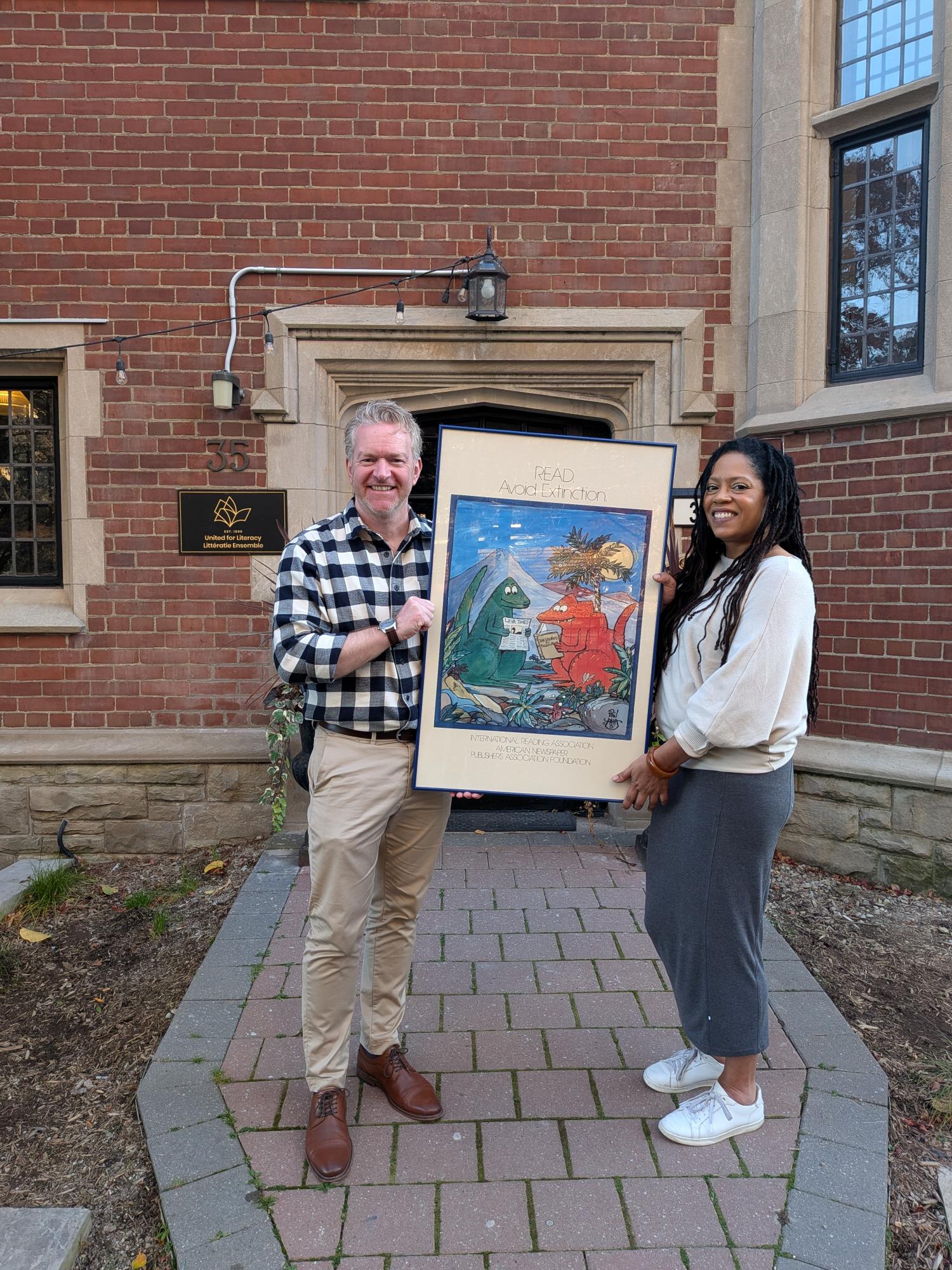
Mélanie Valcin and Richard Harvey holding an illustration from Phil Yeh’s book Theo the Dinosaur.
Text by Mélanie Valcin
President & CEO, United for Literacy
We are teaching machines to read while making it easier for humans to stop reading. That should give us pause.
As the CEO of United for Literacy, I think about this a lot. My team puts so much effort into helping people all across Canada develop their literacy skills. I am not ready to accept that these skills matter less simply because artificial intelligence does more for us.
Of course, I understand how appealing AI may be. When the day is full, who doesn’t appreciate a quick report summary? But if we never see the original, how will we notice what we are missing?
The idea of a ’postliterate society’ is gaining attention. This raises questions about what happens when reading plays a smaller role in how we learn, think and engage with the world around us.
The concern is not simply that people are reading less, it is that we are surrounded by more information than ever, while spending less time engaging deeply with this information.
Canada has many reasons to pay attention to this.
For example, the latest PISA results show that nearly 22 per cent of Canadian students aged 15 do not reach the baseline reading proficiency. These results are not heading in the right direction!
Our young people will soon be making important choices about their health, their finances and the future of our society. They will need strong literacy skills to sort the information they find, understand it, question its reliability and make sound decisions based on this information.
At United for Literacy, we believe every young person deserves the support to develop those skills and use them with confidence. Some individuals can access resources to help in the development of these skills, but some face barriers.
I am sure you agree with us that we cannot solely blame rapid technological changes for Canada’s PISA results. But these technological changes do raise important questions about how prepared we are to navigate an increasingly digital world.
Back in 1991, cartoonist Phil Yeh made the case for reading with a message that is still relevant today: Read. Avoid extinction. In his book Theo the Dinosaur, four dinosaurs escape extinction because they learn to read. Today, as a growing number of AI scientists warn us that artificial intelligence could threaten our very survival, that slogan has taken on an uncomfortable new relevance.
So here is the question I keep coming back to: Will we and the next generations have the literacy and critical thinking skills to question the tools and the information we are increasingly being encouraged to trust?
The solution I propose is to have a reading revolution built around 3Rs: Resilience, Rebellion and Resistance:
Resilience
I start with resilience because reading sometimes asks us to work through something difficult. We come across an unfamiliar word or an idea that challenges what we believe. We may need to read a paragraph twice or leave a question unanswered for a while. Staying with it makes us practise handling uncertainty. We learn that we can struggle with something and still find our way through it. That is an important skill, not only for reading, but for life.
Rebellion
Rebellion, for me, is about taking back some control over who and what gets our attention. It can start with choosing a book outside our usual interests or reading an author whose views we might not agree with. A librarian or a friend might suggest something we would never have picked up ourselves. There is freedom in following that curiosity instead of always accepting what is suggested to us and appears on our screens. And honestly, I find great pleasure in discovering something I was never looking for. Actually, some of the best things I discover are the things no algorithm would have thought to show me.
Resistance
And resistance you might ask?
This is where we take the time to question what we read. Who is saying this? What evidence do they have? What might be missing? A headline may leave out information that completely changes the story. An opinion can sound convincing without being supported by facts. Reading carefully helps us resist the pressure to react before we understand. And that also means looking closely at claims we want to believe.
Twenty-two per cent is not just a statistic. It points to a real need for organizations that can meet our youth where they are and help them build the literacy skills they need to have the confidence they need.
That is exactly what we do at United for Literacy. Last year, we reached nearly 30,000 people in communities across Canada. But that is not enough. If we are serious about a reading revolution, it has to reach people who face barriers to education and learning, wherever they are and at whatever stage of life they are in.
Some learners need one-on-one tutoring. Others need accessible materials or opportunities that fit around work and family responsibilities. That is why we adapt our programs to each learner’s skills, circumstances and goals. We also work in partnership with organizations that are already rooted in their communities, bringing learning into places where people already gather, including shelters, detention centres, settlement agencies, libraries and other community organizations.
But no organization can do this alone. A revolution needs people. That is why we co-founded the National Literacy Alliance, which is calling for a national literacy strategy. Other countries have already put national strategies in place to support literacy. Canada needs a coordinated, long-term approach of its own, with sustained investment and clear responsibility for supporting learners throughout their lives. Such a commitment must work in complementary alignment with adult literacy needs and include adult literacy as part of that commitment, alongside early learning and the mandatory school years.
As Canada invests in artificial intelligence and embraces rapidly evolving technologies, we must also invest in the people who will use them. Everyone should have the opportunity to read, understand and make up their own mind.
Read. Avoid extinction. Take part in a reading revolution. Those dinosaurs may have been onto something…
–
By Mélanie Valcin
President & CEO, United for Literacy
Mélanie Valcin holds a Master’s degree in International and Community Development from the University of Toronto, as well as an Executive Education certificate in nonprofit management from Harvard Business School. She has spent over 20 years advancing social innovation, youth mobilization and community development. Before joining United for Literacy (formerly Frontier College), she held roles with the Canadian Red Cross, Monash University in Australia and the United Nations Development Fund for Women (UNIFEM) in Mexico. She currently serves on the boards of Le Devoir, Imagine Canada and the National Alliance for Children and Youth. In 2022, she was recognized as a Black Changemaker by the CBC and is a member of Groupe des Trente, which promotes diversity in leadership and governance.